What Is a Rashi Moon Sign in Jyotish
What is a rashi moon sign, and why does it differ from a Western sun sign? A clear guide to how rashis work in Jyotish.
What Your Rashi Actually Is
Your Chandra Rashi (the rashi occupied by the Moon at your birth) is not a sun sign. It is not a Western star sign with a Sanskrit label attached. In Jyotish, the Moon's placement carries more interpretive weight than the Sun's, and the rashi it occupies is the primary lens through which your chart is read.
A rashi is a 30-degree division of the ecliptic, the apparent path the Sun and planets trace across the sky. There are twelve of them, each spanning exactly 30 degrees of arc, and together they complete the full 360-degree circle. The word rashi itself refers to a heap or accumulation, a portion of the sky gathered into one coherent field of meaning.
Every graha (one of the nine moving bodies of Jyotish) occupies a rashi at any given moment. The rashi it falls in shapes how that graha expresses itself in the chart. The rashi is the field; the graha is the actor working within it.
When someone says "my Moon sign is Scorpio" using Western astrology, they mean something calculated differently from a Jyotish reading of the same birth. The rashi system and the Western sign system share names and a rough historical origin, but they are not the same thing, and treating them as interchangeable produces a different chart.
Sidereal and Tropical: Why the Numbers Differ
This is where most confusion starts, and it deserves a direct answer. Western astrology measures signs from the vernal equinox, a moving point in the sky called the tropical zero point. Jyotish measures rashis from a fixed point among the stars, called the sidereal zero point. These two starting points have drifted apart over the centuries, and they are currently separated by roughly 24 degrees.
That gap is called the ayanamsha (the degree of separation between the two systems). This site uses the Lahiri ayanamsha, the version adopted by the Indian government's calendar reform committee and the most widely used in contemporary Jyotish practice. Because the two starting points differ by close to an entire rashi, many readers find that their Vedic rashi is the one immediately before their Western sign. Someone who has always identified as a Western Sagittarius may find their Chandra Rashi is Vrishchika. Someone who thought they were a Taurus Moon may find their rashi is Mesha.
Neither system is wrong on its own terms. They are measuring different things from different reference points. But they cannot be mixed: a Jyotish reading done with Western sign positions, or a Western reading done with sidereal positions, produces a hybrid that belongs to neither tradition.
If you have ever had a reading that felt off, or been told something about yourself that did not fit, checking whether the system used was sidereal or tropical is a reasonable first step.
Chandra Rashi, Not Sun Sign
In Jyotish, the Moon is not a secondary luminary. Chandra (the Moon) governs the mind, the emotional body, habitual responses, and the felt sense of self. The rashi Chandra occupies at birth describes the emotional texture of a person's inner life more directly than the Sun's position does.
The Lagna (the rising point, the degree of the ecliptic crossing the eastern horizon at the moment of birth) is also central to a full reading. The Lagna describes the body, the outer personality, and the direction of the life. The Chandra Rashi describes what is happening inside. Both matter. Neither replaces the other.
When someone in Jyotish asks "what is your rashi," they are almost always asking about the Chandra Rashi. This is the rashi used for Guna Milan compatibility scoring, for tracking Gochara (transits) including the Sade Sati period of Shani, and for the emotional tone of Vimshottari Dasha periods. It is the anchor point of the chart's experiential dimension.
The Sun's rashi matters too, but it is read as one placement among many, not as the defining identity marker that Western sun-sign astrology has made it.
Elements and Modalities
Each rashi belongs to one of four elements and one of three modalities. These cycle in a fixed sequence across all twelve rashis.
The four elements are Agni (fire), Prithvi (earth), Vayu (air), and Jala (water). They repeat in that order across the twelve rashis, so consecutive rashis always differ in element. Mesha is Agni, Vrishabha is Prithvi, Mithuna is Vayu, Karka is Jala, and the cycle continues. This means every pair of adjacent rashis operates in a different elemental register.
The three modalities are Chara (movable), Sthira (fixed), and Dvisvabhava (dual, sometimes called mutable). These also cycle in sequence: Mesha is Chara, Vrishabha is Sthira, Mithuna is Dvisvabhava, Karka is Chara again, and so on. A Chara rashi favors initiation and adaptability. A Sthira rashi favors consolidation and endurance. A Dvisvabhava rashi holds qualities of both and tends toward versatility.
These qualities shape how a graha placed in the rashi operates. A graha in a Sthira rashi tends to stabilize and concentrate its significations. A graha in a Chara rashi tends to move, initiate, and shift. These are tendencies read in combination with the graha's own nature, not rules that override everything else.
The Rashi Lords
Every rashi has a ruling graha, called its rashi lord or rashi adhipati. Surya (the Sun) rules Simha. Chandra rules Karka. Those are the only two rashis ruled by a single graha each. The remaining five grahas, Mangal (Mars), Budh (Mercury), Guru (Jupiter), Shukra (Venus), and Shani (Saturn), each rule two rashis.
Mangal rules Mesha and Vrishchika. Shukra rules Vrishabha and Tula. Budh rules Mithuna and Kanya. Guru rules Dhanu and Meena. Shani rules Makara and Kumbha. Rahu and Ketu, the lunar nodes, rule no rashi.
The rashi lord matters because it links the rashi to a graha that can be tracked through the chart. If Chandra occupies Kanya, then Budh is the lord of the Chandra Rashi, and Budh's own placement, dignity, and condition in the chart will color how the Moon expresses itself. A well-placed rashi lord supports the graha it governs. A rashi lord placed in difficulty creates friction for the graha sitting in that rashi.
This is one of the reasons two people with the Moon in the same rashi can experience that placement very differently. The rashi is one layer. The rashi lord's condition is another. The nakshatra (one of the twenty-seven lunar mansions, each spanning 13 degrees and 20 minutes of arc) the Moon occupies within the rashi is a third. The nakshatra system carries its own set of lords, qualities, and timing mechanisms that operate alongside the rashi framework, not instead of it.
One thing the rashi does not carry: a Vimshottari Dasha lord. That belongs entirely to the nakshatra. The nakshatra in which Chandra sits at birth determines which Dasha period is running and in what sequence the others follow. Assigning a Dasha lord to a rashi is a common error, and it produces the wrong timing for everything that follows.
How a Rashi Is Actually Read
A rashi is never read in isolation. It is a field that conditions every graha placed within it, and its meaning emerges through the full chart rather than as a standalone description.
The first step is identifying which bhava (one of the twelve life areas of the chart) the rashi occupies from the Lagna. The same rashi will fall in a different bhava for different Lagnas. Mesha falling in the 1st bhava reads differently from Mesha falling in the 7th bhava. The rashi describes the quality of the field; the bhava describes which area of life that field activates.
The second step is noting which grahas occupy the rashi. A rashi with no graha in it is not empty of meaning. Its lord still connects it to another part of the chart. But a rashi with one or more grahas in it becomes a site of activity, and the nature of those grahas, their dignities, their mutual relationships, and the aspects (drishti, the gaze a graha casts on another part of the chart) they receive all become part of the reading.
The third layer is the nakshatra. Each rashi contains two or three nakshatras. A graha placed in Vrishabha at 10 degrees is in a different nakshatra than a graha placed in Vrishabha at 25 degrees, and those nakshatras carry different qualities and different Vimshottari lords. Reading the nakshatra within the rashi adds precision that the rashi alone cannot supply.
The twelve rashi pages here each take up one of these placements in depth. Mesha Rashi, Vrishabha Rashi, Mithuna Rashi, Karka Rashi, Simha Rashi, Kanya Rashi, Tula Rashi, Vrishchika Rashi, Dhanu Rashi, Makara Rashi, Kumbha Rashi, and Meena Rashi each cover the rashi's element, modality, lord, the nakshatras it contains, and how the Moon expresses itself when placed there.
Gochara, the movement of grahas through rashis in real time, is a separate but related layer of interpretation. The rashi a graha transits activates that rashi's bhava from your Lagna and from your Chandra Rashi simultaneously. The complete guide to Gochara covers how those moving layers are read together with the natal chart.
For compatibility readings, the Chandra Rashi is one of the primary inputs into Ashtakoot matching, the eight-score system used to assess the compatibility of two charts. The rashi's element, modality, and lord all feed into different kootas within that framework.
If you have been told that a particular rashi placement means something fixed and final about your life, that is not how the system works. A rashi is a quality of the field. What you do within that field, and how the rest of the chart supports or complicates it, is where the real reading lives.
Highlight by Vimshottari lord

Mesha
Aries · Mangal (Mars)
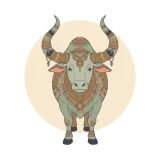
Vrishabha
Taurus · Shukra (Venus)
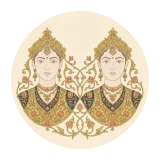
Mithuna
Gemini · Budha (Mercury)

Karka
Cancer · Chandra (Moon)

Simha
Leo · Surya (Sun)
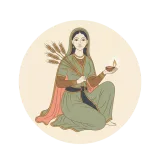
Kanya
Virgo · Budha (Mercury)
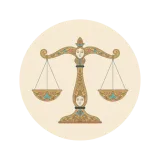
Tula
Libra · Shukra (Venus)

Vrishchika
Scorpio · Mangal (Mars)
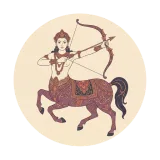
Dhanu
Sagittarius · Guru (Jupiter)
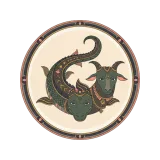
Makara
Capricorn · Shani (Saturn)
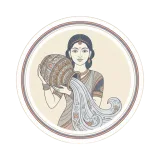
Kumbha
Aquarius · Shani (Saturn)
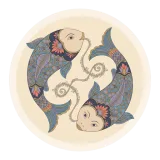
Meena
Pisces · Guru (Jupiter)